HIROSHIMA AND NAGASAKI

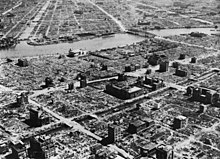
 In August 1945, during the final stage of the Second World War, the United States dropped atomic bombs on the Japanese cities of Hiroshima and Nagasaki. The two bombings, which killed at least 129,000 people, remain the only use of nuclear weapons for warfare in human history.As the Second World War entered its sixth and final year, the Allies had begun to prepare for, what was anticipated to be, a very costly invasion of the Japanese mainland. This was preceded by an immensely destructive firebombing campaign that obliterated many Japanese cities. The war in Europe had concluded when Nazi Germany signed its instrument of surrender on May 8, 1945, but with the Japanese refusal to accept the Allies' demands for unconditional surrender, the Pacific War dragged on. Together with the United Kingdom and China, the United States' calls for the unconditional surrender of the Japanese armed forces in the Potsdam Declaration on July 26, 1945 was buttressed with the threat of "prompt and utter destruction".
 PACIFIC WAR
In 1945, the Pacific War between the Empire of Japan and the Allies entered its fourth year. Of the 1.25 million battle casualties incurred by the United States in World War II, including both military personnel killed in action and wounded in action, nearly one million occurred in the twelve-month period from June 1944 to June 1945. December 1944 saw American battle casualties hit an all-time monthly high of 88,000 as a result of the German Ardennes Offensive. In the Pacific the Allies returned to the Philippines, recaptured Burma, and invaded Borneo.
HIROSHIMA DURING WORLD WAR II
 At the time of its bombing, Hiroshima was a city of both industrial and military significance. A number of military units were located nearby, the most important of which was the headquarters of Field Marshal Shunroku Hata's Second General Army, which commanded the defense of all of southern Japan, and was located in Hiroshima Castle. Hata's command consisted of some 400,000 men, most of whom were on Kyushu where an Allied invasion was correctly anticipated. Also present in Hiroshima were the headquarters of the 59th Army, the 5th Division and the 224th Division, a recently formed mobile unit.
 THE BOMBING
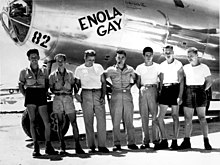
Hiroshima was the primary target of the first nuclear bombing mission on 6 August, with Kokura and Nagasaki as alternative targets. The 393d Bombardment Squadron B-29 Enola Gay, piloted by Tibbets, took off from North Field, Tinian, about six hours' flight time from Japan. The Enola Gay (named after Tibbets' mother) was accompanied by two other B-29s. The Great Artiste, commanded by Major Charles Sweeney, carried instrumentation, and a then-nameless aircraft later called Necessary Evil, commanded by Captain George Marquardt, served as the photography aircraft.

 In August 1945, during the final stage of the Second World War, the United States dropped atomic bombs on the Japanese cities of Hiroshima and Nagasaki. The two bombings, which killed at least 129,000 people, remain the only use of nuclear weapons for warfare in human history.As the Second World War entered its sixth and final year, the Allies had begun to prepare for, what was anticipated to be, a very costly invasion of the Japanese mainland. This was preceded by an immensely destructive firebombing campaign that obliterated many Japanese cities. The war in Europe had concluded when Nazi Germany signed its instrument of surrender on May 8, 1945, but with the Japanese refusal to accept the Allies' demands for unconditional surrender, the Pacific War dragged on. Together with the United Kingdom and China, the United States' calls for the unconditional surrender of the Japanese armed forces in the Potsdam Declaration on July 26, 1945 was buttressed with the threat of "prompt and utter destruction".